

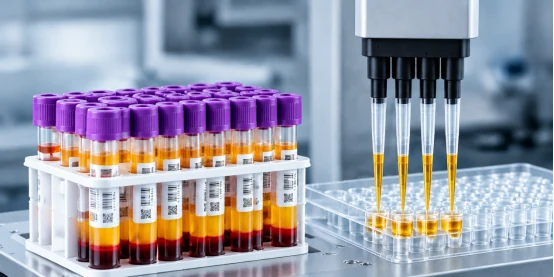
Preserve identity from the parent tube to the destination
Capture the accession or approved specimen identifier at intake. Tie every destination tube or well to the source, its position and the transfer record. Verify identifiers at the point of transfer where the workflow supports it. Unreadable labels, unexpected positions and duplicate identifiers should have defined exception paths so a missing scan cannot silently become a successful transfer. [1] [2]
A readable barcode proves that a label can be read. The workflow should also resolve whether it belongs to the loaded specimen and the planned order. Test parent-to-child traceability when racks are partially full or remapped, including scenarios where an operator intervenes after a pause. [1]
Check suitability before transferring the specimen
Specimen type, tube and additive, available volume, handling time and condition can matter to the receiving test. Use the assay's validated acceptance criteria and the laboratory's specimen-management procedure to decide what can move forward. Distinguish a low-volume warning, an instrument fault and an unsuitable specimen in the recorded outcome so the laboratory can respond appropriately. [2] [3]
A liquid-level signal provides information about the detected surface. It does not on its own demonstrate that an aspiration produced an acceptable aliquot. Evaluate the effects of fill level, tube geometry, foam or bubbles and the sensitivity of the intended assay using representative material under the laboratory's approved validation plan. [2]
Measure carryover and precision at the workflow level
Use separately defined checks for transfer performance and assay performance. Measure volume bias and repeatability across relevant channels and conditions. Evaluate carryover on a complete worklist using a justified challenge sequence and examine the downstream low-level results. Carryover can follow a shared fluid path, nearby positions or a sequence of operations, so preserve the order and channel assignment in the evidence. [3] [4]
An acceptable average across a plate can coexist with a weak channel or with a problem after a long pause. Compare results by channel, run and condition, and use acceptance limits linked to the method's allowable error. Investigate repeating patterns before expanding the range of specimen types or volumes. [3] [4]
Make fault recovery part of qualification
Simulate a failed cap operation, rejected scan or interruption during a transfer with surrogate materials. Verify where the instrument resumes, what remains held for review and whether a partially filled output can be identified. Keep the original event, any retry and the disposition visible in the run record. A speed improvement is valuable only when the laboratory can account for every output specimen. [1] [2]